

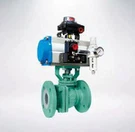
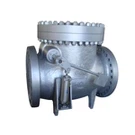
Hey there! As a supplier of soft seated ball valves, I've had my fair share of customers asking about the flow characteristics of these valves. So, I thought I'd write this blog to break it down in a simple and easy - to - understand way.
Let's start with the basics. A soft seated ball valve is a type of valve that uses a soft material, like rubber or PTFE, for the valve seat. This soft seat provides a tight seal against the ball, which is great for preventing leakage. But what about how it affects the flow of fluid through the valve?
Flow Coefficient (Cv)
One of the key things to understand about the flow characteristic of a soft seated ball valve is the flow coefficient, often referred to as Cv. The Cv value tells you how much fluid can pass through the valve at a given pressure drop. A higher Cv means more fluid can flow through the valve for a specific pressure difference.
Soft seated ball valves generally have a relatively high Cv value. This is because the ball in a ball valve has a large opening in the middle. When the valve is fully open, the ball's opening aligns with the pipe, creating a straight - through path for the fluid. This straight - through design minimizes the resistance to flow, allowing a large volume of fluid to pass through.
For example, if you're dealing with a large - diameter soft seated ball valve in a water supply system, the high Cv value means that you can deliver a significant amount of water with a relatively small pressure drop. This is important for reducing energy consumption in pumping systems.
Flow Patterns
The flow pattern through a soft seated ball valve is also an important aspect. When the valve is fully open, the flow is mostly laminar in the straight - through section of the valve. Laminar flow is characterized by smooth, parallel layers of fluid moving in the same direction. This is ideal because it reduces turbulence and energy losses.
However, as the valve starts to close, the flow pattern changes. The fluid has to pass through a smaller opening, which causes the flow to become more turbulent. Turbulence can lead to increased pressure drop and energy losses. But in some cases, this can also be beneficial. For instance, in applications where you need to mix fluids, the turbulence created by a partially closed soft seated ball valve can help with the mixing process.


Flow Control
Soft seated ball valves are excellent for on - off control. When the valve is fully open, it allows maximum flow, and when it's fully closed, it completely stops the flow. But they can also be used for throttling applications, where you need to control the flow rate.
When using a soft seated ball valve for throttling, it's important to understand that the relationship between the valve opening and the flow rate is not always linear. In the initial stages of opening the valve, a small change in the valve position can result in a large change in the flow rate. As the valve approaches full open, the change in flow rate for a given change in valve position becomes smaller.
This non - linear flow characteristic can be both an advantage and a disadvantage. On one hand, it allows for precise control at low flow rates. On the other hand, it can make it more challenging to achieve accurate flow control over a wide range of flow rates.
Comparison with Other Types of Valves
Let's compare the flow characteristics of soft seated ball valves with some other types of valves.
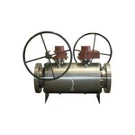
Fully Welded Ball Valve: A Fully Welded Ball Valve has a similar flow characteristic to a soft seated ball valve in terms of the straight - through design when fully open. However, fully welded ball valves are often used in high - pressure and high - temperature applications. They are more robust and can handle more extreme conditions. But in terms of flow control, the basic principles of flow coefficient and non - linear throttling are similar to soft seated ball valves.
Ceramic Lined Ball Valve: Ceramic Lined Ball Valve is another type. The ceramic lining provides excellent wear resistance, which is useful in applications with abrasive fluids. The flow characteristics are similar to soft seated ball valves in terms of the ball - and - seat design. But the ceramic material may have a slightly different effect on the flow due to its surface properties. The smooth ceramic surface can reduce friction and improve the flow efficiency to some extent.
V Port Ball Valve: A V Port Ball Valve has a different flow characteristic compared to a standard soft seated ball valve. The V - shaped opening in the ball of a V port ball valve provides a more linear relationship between the valve opening and the flow rate. This makes it more suitable for applications where precise flow control over a wide range is required, such as in chemical processing plants.
Factors Affecting Flow Characteristics
Several factors can affect the flow characteristics of a soft seated ball valve.
Valve Size: Larger - diameter valves generally have higher Cv values because they can accommodate more fluid. However, the relationship between valve size and Cv is not always proportional. Other factors, such as the internal design of the valve, also play a role.
Seat Material: The type of soft seat material can affect the flow. For example, a PTFE seat is very smooth, which can reduce friction and improve the flow efficiency. On the other hand, a rubber seat may have a slightly higher friction coefficient, which could result in a slightly higher pressure drop.
Fluid Properties: The properties of the fluid, such as viscosity, density, and temperature, can also impact the flow. High - viscosity fluids, like oil, will experience more resistance to flow compared to low - viscosity fluids like water. Temperature can also affect the viscosity of the fluid, which in turn affects the flow through the valve.
Applications and Flow Requirements
The flow characteristics of soft seated ball valves make them suitable for a wide range of applications.
In the oil and gas industry, soft seated ball valves are used in pipelines for on - off control of crude oil, natural gas, and refined products. The high Cv value allows for efficient transportation of large volumes of these fluids.
In the water treatment industry, soft seated ball valves are used for controlling the flow of water in treatment plants. They can handle both clean water and wastewater, and their ability to provide a tight seal is crucial for preventing leaks.
In the chemical industry, soft seated ball valves are used for handling various chemicals. The choice of seat material is important in this industry to ensure compatibility with the chemicals. And the ability to control the flow precisely is necessary for accurate chemical dosing.
Conclusion
In conclusion, the flow characteristic of a soft seated ball valve is a complex but important topic. The high Cv value, the changing flow patterns with valve position, and the non - linear flow control are all key aspects to consider. Understanding these characteristics can help you choose the right valve for your specific application.
If you're in the market for soft seated ball valves or want to learn more about how they can meet your flow requirements, I'd love to have a chat. Whether you need a valve for a large - scale industrial application or a small - scale project, we've got the expertise to help you make the right choice. Contact us for a detailed discussion on your valve needs and let's work together to find the perfect solution.
References
- Valve Handbook, Second Edition by Ernest O. Hensley
- Fluid Mechanics and Hydraulics by Robert L. Mott