

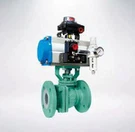
Hey there! As a supplier of fully welded ball valves, I've been getting a bunch of questions lately about what types of actuators are suitable for these valves. So, I thought I'd write this blog to share some insights and help you make the right choice.
First off, let's quickly understand what a fully welded ball valve is. It's a valve where the body is completely welded, which gives it excellent strength and tightness. These valves are commonly used in high - pressure and high - temperature applications, like in oil and gas pipelines, chemical plants, and power generation facilities.
Now, let's dive into the different types of actuators and see which ones are a good fit for fully welded ball valves.
Electric Actuators
Electric actuators are super popular, and for good reasons. They're easy to install and operate. You can control them remotely, which is a huge plus in many industrial settings. All you need is an electrical power source, and you're good to go.
One of the main advantages of electric actuators is their precision. They can be programmed to open or close the valve at specific angles or with a specific torque. This is really important in applications where you need accurate flow control. For example, in a chemical plant, you might need to control the flow of different chemicals precisely to ensure the quality of the final product.
Another great thing about electric actuators is their reliability. They have fewer moving parts compared to some other types of actuators, which means less maintenance. You don't have to worry about things like hydraulic fluid leaks or air compressor failures.
However, electric actuators do have some drawbacks. They can be a bit slow compared to pneumatic actuators. If you need a valve to open or close very quickly, an electric actuator might not be the best choice. Also, they require a continuous supply of electricity. If there's a power outage, the actuator won't work unless you have a backup power source.
Pneumatic Actuators
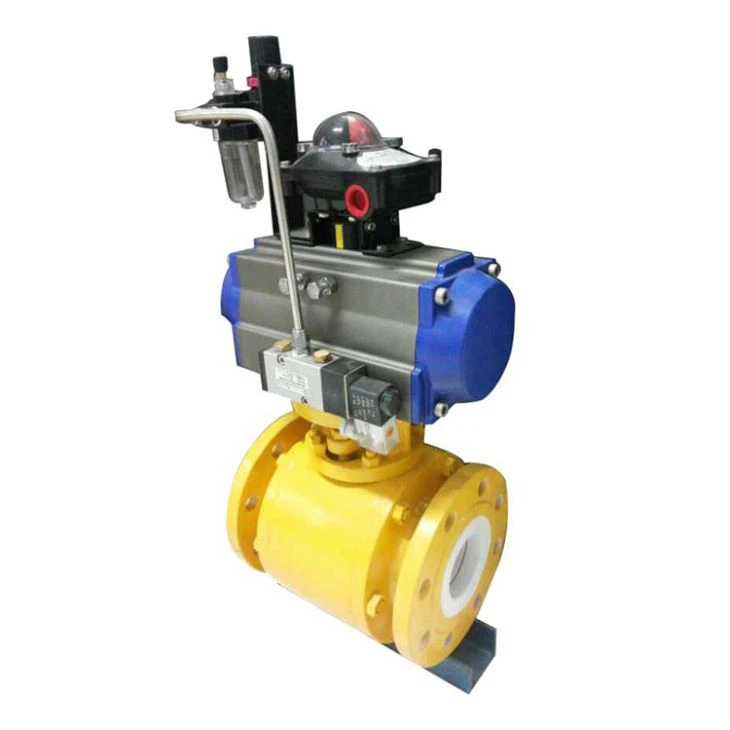
Pneumatic actuators use compressed air to operate the valve. They're known for their speed and simplicity. If you need a valve to open or close in a split - second, a pneumatic actuator is your best bet.
These actuators are also very cost - effective. Compressed air is usually readily available in industrial facilities, so you don't have to invest in a separate power source like you do with electric actuators. They're also relatively easy to maintain. You just need to make sure the air supply is clean and dry to prevent corrosion and damage to the actuator.
One of the downsides of pneumatic actuators is that they can be a bit noisy. The sudden release of compressed air can create a lot of noise, which might be a problem in some work environments. Also, they're not as precise as electric actuators. If you need very accurate flow control, a pneumatic actuator might not be able to provide the level of precision you need.
Hydraulic Actuators
Hydraulic actuators use hydraulic fluid to generate the force needed to operate the valve. They're extremely powerful and can handle high - torque applications. If you have a large fully welded ball valve that needs to be operated in a high - pressure environment, a hydraulic actuator is often the best choice.
These actuators can provide a lot of force in a small package. They're also very reliable and can operate in harsh conditions. For example, in an offshore oil rig, where the valve might be exposed to saltwater and extreme temperatures, a hydraulic actuator can still perform well.

However, hydraulic actuators are more complex and expensive than electric and pneumatic actuators. They require a hydraulic power unit, which includes a pump, reservoir, and control valves. This means more maintenance and a higher initial cost. Also, hydraulic fluid leaks can be a problem, which can be messy and potentially dangerous if the fluid is flammable.
Which Actuator is Right for You?
The choice of actuator depends on several factors. First, you need to consider the application. If you need precise flow control, an electric actuator might be the best choice. If you need a fast - acting valve, a pneumatic actuator could be more suitable. And if you're dealing with a high - torque, high - pressure application, a hydraulic actuator might be the way to go.
You also need to think about the environment in which the valve will be operating. If it's a harsh environment with extreme temperatures or corrosive substances, you need an actuator that can withstand these conditions. For example, in a chemical plant, you might need an actuator with a corrosion - resistant coating.
Cost is another important factor. Electric actuators are generally more expensive upfront but can save you money in the long run due to lower maintenance costs. Pneumatic actuators are usually the most cost - effective option, while hydraulic actuators are the most expensive.
As a fully welded ball valve supplier, I can help you choose the right actuator for your specific needs. We also offer a wide range of fully welded ball valves, including Ceramic Lined Ball Valve, Top Entry Ball Valve, and DBB ball valve.
If you're interested in learning more about our products or need help choosing the right actuator for your fully welded ball valve, don't hesitate to reach out. We're here to assist you in making the best decision for your application.
Conclusion
In conclusion, there are several types of actuators suitable for fully welded ball valves, each with its own advantages and disadvantages. Electric actuators offer precision and reliability, pneumatic actuators provide speed and cost - effectiveness, and hydraulic actuators are powerful and can handle high - torque applications. By considering your specific application, environment, and budget, you can choose the actuator that's right for you.
If you have any questions or need further assistance, feel free to contact us. We're always happy to help you find the perfect solution for your valve needs.
References
- "Valve Handbook" by Thurnherr, M.
- "Actuators: A Practical Guide" by Johnson, R.