

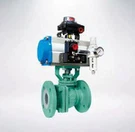
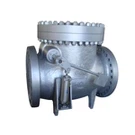
Hey there! As a supplier of Swing Type Check Valves, I've had my fair share of customers scratching their heads over how to pick the right valve, especially when it comes to fluid density. So, I thought I'd share some tips on how to select a Swing Type Check Valve based on the fluid density.
First off, let's understand what a Swing Type Check Valve is. A Swing Type Check Valve is a type of valve that allows fluid to flow in one direction only. It has a disc that swings on a hinge, and when the fluid flows in the right direction, the disc opens, allowing the fluid to pass through. When the flow reverses, the disc swings back and closes, preventing the backflow of the fluid. You can learn more about Swing Type Check Valves here.
Now, let's talk about fluid density. Fluid density is basically how much mass a fluid has per unit volume. It can vary a lot depending on the type of fluid, its temperature, and pressure. For example, water at room temperature has a density of about 1000 kg/m³, while oil can have a density anywhere from 800 to 900 kg/m³.
So, why does fluid density matter when selecting a Swing Type Check Valve? Well, the density of the fluid affects how the valve operates. A denser fluid will exert more force on the valve disc, which means the valve needs to be able to handle that extra force. If the valve is not designed to handle the density of the fluid, it might not close properly, leading to backflow, or it could even get damaged over time.
Low - Density Fluids
When dealing with low - density fluids like natural gas or some light solvents, you need a valve that can open easily with minimal pressure. Low - density fluids don't exert a lot of force on the valve disc. So, a valve with a lightweight disc and a low cracking pressure is ideal. The cracking pressure is the minimum pressure required to open the valve. For low - density fluids, a valve with a cracking pressure of around 0.5 to 2 psi might be sufficient.
One thing to keep in mind is that low - density fluids can flow very fast. So, the valve should also be able to handle high flow rates without causing too much pressure drop. Some Swing Type Check Valves are designed with streamlined bodies to reduce turbulence and pressure drop, which is great for low - density fluids.
High - Density Fluids
On the other hand, high - density fluids like thick slurries or heavy oils require a valve that can withstand the high forces exerted by the fluid. The valve disc needs to be strong enough to close tightly against the high - pressure backflow. A valve with a heavy - duty disc and a robust hinge mechanism is a must.
High - density fluids also tend to be more viscous, which means they flow more slowly. The valve should be designed to allow the fluid to flow smoothly without getting stuck. Some valves have special coatings or linings to reduce friction and prevent the fluid from sticking to the valve surfaces. For example, the Ball Float Pattern Rubber Lined Check Valve can be a good option for high - density and viscous fluids as the rubber lining can reduce friction and improve the valve's performance.
Medium - Density Fluids
Most common fluids fall into the medium - density category, like water and many common chemicals. For these fluids, a standard Swing Type Check Valve usually works well. The valve should have a balanced design that can handle the normal forces exerted by the fluid. A medium - cracking pressure, around 2 to 5 psi, is typically suitable for medium - density fluids.
However, you still need to consider other factors like the temperature and corrosiveness of the fluid. If the fluid is corrosive, you might need a valve made of corrosion - resistant materials like stainless steel or have a special coating.


Comparing with Other Types of Check Valves
It's also worth comparing Swing Type Check Valves with other types of check valves, like the Dual Plate Check Valve. Dual Plate Check Valves are often more compact and have a lower pressure drop compared to Swing Type Check Valves. But when it comes to handling high - density fluids, Swing Type Check Valves usually have an edge because of their larger and stronger discs.
Installation and Maintenance
Once you've selected the right Swing Type Check Valve based on the fluid density, proper installation and maintenance are crucial. Make sure the valve is installed in the correct orientation, with the flow arrow on the valve body matching the direction of the fluid flow. Regular maintenance, like checking the valve disc for wear and tear and lubricating the hinge if necessary, can extend the life of the valve.
Conclusion
Selecting the right Swing Type Check Valve based on the fluid density is not rocket science, but it does require some knowledge and careful consideration. By understanding the characteristics of the fluid, you can choose a valve that will work efficiently and last a long time.
If you're in the market for a Swing Type Check Valve and need some help with the selection process, don't hesitate to reach out. We're here to assist you in finding the perfect valve for your specific application. Whether it's a low - density gas or a high - density slurry, we've got the expertise to guide you through the selection and make sure you get a valve that meets your needs. Contact us for a detailed discussion and let's start the procurement process together!
References
- "Valve Handbook: Principles and Applications" by Thomas R. Kister
- "Fluid Mechanics and Hydraulics" by Jack B. Evett and Carl S. Liu