

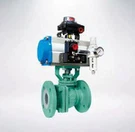
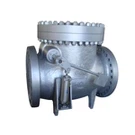
Hey there! As a supplier of Automatic Control Valves, I often get asked how these nifty devices adjust to changes in fluid density. It's a fascinating topic, and I'm stoked to share some insights with you all.
First off, let's understand the basics. An Automatic Control Valve is a crucial component in many systems that handle fluids, like water, oil, or gas. Its main job is to regulate the flow of the fluid, maintain pressure, and sometimes control the level of the fluid in a tank. But when the density of the fluid changes, things can get a bit tricky.
Now, you might be wondering why fluid density changes in the first place. Well, there are several reasons. Temperature is a big one. When a fluid gets heated up, its molecules start moving around more, spreading out and making the fluid less dense. On the other hand, when it cools down, the molecules get closer together, increasing the density. Pressure can also affect density. Higher pressure can compress a fluid, making it denser. And then there are changes in the chemical composition of the fluid, which can also lead to density variations.
So, how does an Automatic Control Valve deal with these changes? One of the main ways is through the use of sensors. These sensors are like the valve's eyes and ears, constantly monitoring the fluid's properties, including density. There are different types of sensors that can measure density, such as vibrating - type sensors. These work by vibrating a tube or a probe in the fluid. The frequency of the vibration changes depending on the density of the fluid. The sensor then sends this information to the valve's control system.
Once the control system gets the density data, it can make adjustments to the valve. For example, if the fluid density decreases, the valve might need to adjust the flow rate. A lower - density fluid might require a higher flow rate to maintain the same level of performance in the system. The control system can calculate the appropriate changes and send signals to the valve actuator.
The valve actuator is like the muscle of the Automatic Control Valve. It's what physically moves the valve to open or close it to the correct position. Based on the signals from the control system, the actuator can make precise adjustments to the valve opening. This ensures that the flow of the fluid remains stable, even when the density changes.
Let's talk about some of the specific types of Automatic Control Valves we offer and how they adjust to fluid density changes.
Our Remote Control Floating Valve is designed to control the level of fluid in a tank. It uses a float mechanism to sense the fluid level. When the fluid density changes, it can affect the buoyancy of the float. But our valve is equipped with a smart control system that takes into account the density changes and adjusts the float operation accordingly. This way, it can still accurately control the fluid level in the tank, no matter what the density is.
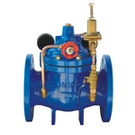
The Control Valve Pressure Reducing Valve is another important component. It's used to reduce the pressure of the fluid to a desired level. Fluid density changes can affect the pressure drop across the valve. Our pressure - reducing valve has a feedback mechanism that uses the density sensor data. If the density changes, the control system can adjust the valve opening to maintain the correct pressure - reducing ratio.
Then there's the Non - Modulating Float Valve. This valve is used in systems where a simple on - off control of fluid flow is required. When the fluid density changes, it can change the force exerted on the float. Our non - modulating float valve has been designed to be robust and can tolerate some degree of density variation. However, for more precise control, the integrated density sensor helps the valve to make minor adjustments to ensure smooth operation.
Another aspect of how Automatic Control Valves adjust to fluid density is through calibration. We calibrate our valves during the manufacturing process to be accurate within a certain range of fluid densities. But in real - world applications, the density can vary beyond this initial range. That's why our valves are designed to be re - calibrated easily. Customers can use our calibration tools and follow the instructions to adjust the valve settings according to the specific fluid density they are dealing with.
In addition to all these technical features, we also offer support to our customers. If you're facing issues with your Automatic Control Valve due to fluid density changes, our team of experts is just a message away. We can provide on - site troubleshooting, software updates, and even custom - made solutions for your specific application.
We understand that every industry has different requirements when it comes to fluid control. For example, the oil and gas industry often deals with fluids of varying densities and viscosities. Our valves are engineered to handle these challenging conditions. They are made from high - quality materials that can resist corrosion and wear, ensuring a long - lasting performance.


The food and beverage industry also has unique needs. Hygiene is a top priority, and the fluids used can have different densities depending on the product. Our Automatic Control Valves are designed to meet strict hygiene standards and can accurately control the flow of these fluids, regardless of density changes.
If you're in the market for an Automatic Control Valve, we've got you covered. Our valves are not only high - performing but also cost - effective. We offer a wide range of models to suit different applications, from small - scale industrial processes to large - scale municipal water systems.
Whether you're looking to upgrade your existing valve or building a new system from scratch, our team can help you choose the right Automatic Control Valve for your needs. We'll take into account the fluid density, the operating pressure, the flow rate, and other factors to ensure you get a valve that works perfectly for you.
So, if you're interested in learning more about our Automatic Control Valves or want to discuss a specific project, don't hesitate to get in touch. We're always ready to have a chat and help you find the best solution for your fluid control challenges.
References:
- "Control Valve Handbook" - A comprehensive guide on control valve technology and operation.
- "Fluid Mechanics and Hydraulics" - A textbook that covers the principles of fluid behavior, including density changes.
- Industry reports on the latest advancements in automatic control valve technology.