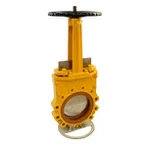
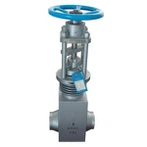
Diaphragm valve is a globe valve that uses a diaphragm as an opening and closing member to close the flow channel, cut off the fluid, and separate the inner cavity of the valve body and the inner cavity of the valve cover. Diaphragms are usually made of elastic, corrosion-resistant, impermeable materials such as rubber and plastic. The valve body is mostly made of plastic, glass fiber reinforced plastic, ceramic or metal rubber-lined material. Simple structure, good sealing and anti-corrosion performance, and small fluid resistance. For low pressure, low temperature, highly corrosive and medium containing suspended substances. According to the structure, it can be divided into roof type, cut-off type, gate type and so on. According to the driving mode, it is divided into manual, pneumatic and electric.
Working principle and composition
The diaphragm valve replaces the valve core assembly with a corrosion-resistant lined valve body and a corrosion-resistant diaphragm, and uses the movement of the diaphragm for adjustment. The body material of the diaphragm valve is cast iron, cast steel, or cast stainless steel, and is lined with various corrosion-resistant or wear-resistant materials, diaphragm material rubber and PTFE. The diaphragm of the lining has strong corrosion resistance and is suitable for the adjustment of strong corrosive media such as strong acid and strong alkali.
The diaphragm valve has a simple structure, small fluid resistance, and a larger flow capacity than other types of valves of the same specification; no leakage, and can be used for the adjustment of high viscosity and suspended particle media. The diaphragm isolates the medium from the upper cavity of the valve stem, so there is no leakage of the medium without packing. However, due to the limitation of diaphragm and lining materials, the pressure resistance and temperature resistance are poor, and it is generally only suitable for nominal pressure of 1.6MPa and below 150℃.
The flow characteristics of the diaphragm valve are close to the quick-opening characteristics, which are approximately linear before 60% of the stroke, and the flow rate after 60% does not change much. Pneumatic diaphragm valves can also be equipped with feedback signals, limiters and positioners to meet the needs of automatic control, program control or flow regulation. The feedback signal of the pneumatic diaphragm valve adopts contactless sensing technology. This product adopts a film-type propulsion cylinder instead of a piston cylinder, which eliminates the disadvantage that the piston ring is easily damaged and causes leakage, which makes it impossible to push the valve to open and close. When the air source fails, the handwheel can still be operated to open and close the valve.