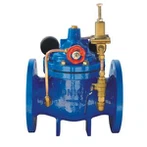
Flash and cavitation of the throttle valve
The liquid flowing in the control valve often has two phenomena: flash and cavitation. Their occurrence not only affects the selection and calculation of caliber, but also leads to serious noise, vibration, material damage and so on. In this case, the working life of the regulating valve will be greatly shortened, which is necessary to elaborate.
Under normal circumstances, as a liquid medium, the flow into, through and out of the regulator are kept liquid.
Flash as a liquid state of the medium, flowing into the regulator is liquid, flowing through the regulator at the shrinkage point of the fluid pressure is lower than the vaporization pressure, the liquid medium into a gaseous medium, and its pressure will not return to the vaporization pressure, the medium has remained gaseous when flowing out of the regulator.
Flash is like a sandblasting phenomenon, which acts on the lower part of the valve body and line, causing serious erosion on the inner surface of the regulator and line, and also reducing the flow capacity of the regulator.
Cavitation as a liquid state of the medium, flowing into the regulator is liquid, flowing through the regulator in the shrinkage of the fluid pressure is lower than the vaporization pressure, the liquid medium into a gaseous medium, then its pressure back to the vaporization pressure, and finally in the outflow of the regulator before the medium into liquid. The existence of cavitation can be preliminatively judged according to some phenomena. When cavitation begins, it will make a "hissing" sound, just like the sound of gravel flowing through the regulator. Cavitation damage to the control valve and the internals is great, and it also reduces the flow efficiency of the control valve, just like flash.
Flash and cavitation of the regulating valve (Figure 1)
Therefore, effective measures must be taken to prevent or minimize the occurrence of flash or cavitation: Try to install the regulator in the lowest position of the system, so that the pressure of the regulator inlet and outlet can be relatively increased.
b. Install a stop valve or throttle orifice plate upstream or downstream of the regulator to change the original installation pressure drop characteristics of the regulator (this method is generally more effective for small flow situations).
C. The selection of special anti-cavitation internals can also effectively prevent flash or cavitation, which can change the flow rate of the fluid in the control valve, thereby increasing the internal pressure.
d. Try to choose a hard material of the control valve, because in the event of cavitation, for such regulation, it has a certain erosion resistance and wear resistance, can make cavitation exist under certain conditions, and will not damage the internal parts of the control valve. On the contrary, for the control valve of soft materials, due to its poor erosion resistance and wear resistance, when cavitation occurs, the internal components of the control valve will soon be worn, and therefore can not work normally in the case of cavitation.
In short, at present, there is no engineering material that can adapt to the cavitation under serious conditions, and it can only be comprehensively analyzed for the objective situation and choose a relatively reasonable solution.