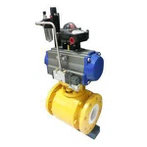
AT pneumatic actuator
AT pneumatic actuators are divided into two forms: positive action and reverse action. The so-called positive action means that the signal pressure increases and the push rod is downward; the reverse action form is that the signal pressure increases and the push rod is upward. The output displacement of this actuator is proportional to the input air pressure signal. The greater the signal pressure, the greater the displacement of the push rod. When the pressure and the reaction force of the spring are balanced, the push rod is stabilized at a certain position, and AT pneumatic actuators have two types of angular stroke pneumatic actuators and straight stroke pneumatic actuators. With the continuous development of intelligent pneumatic actuators, intelligent valve positioners have become indispensable supporting products. The intelligent valve positioner is equipped with a highly integrated microcontroller, which uses the electric balance (digital balance) principle instead of the traditional force balance principle, and converts the electric control commands into pneumatic positioning increments to achieve valve position control; using digital open and stop And off signals to drive the action of the pneumatic actuator; the valve position feedback signal directly passes through the high-precision position sensor to realize the electric / pneumatic conversion function. The intelligent valve positioner has the characteristics of improving output force and action speed, adjusting accuracy, overcoming valve stem friction and realizing correct positioning. It is because of the continuous intelligence of these supporting products that the pneumatic actuators are more intelligent