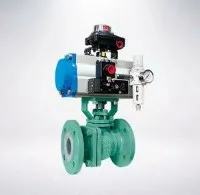
The main difference between a ball valve and a gate valve is the way they control the flow of fluid.
A ball valve controls fluid flow using a hollow sphere (the ball) with a hole through its center. When the valve is open, the hole in the ball is aligned with the flow path, allowing fluid to pass through the valve. When the valve is closed, the ball is rotated so that the hole is perpendicular to the flow path, stopping the flow of fluid.
A gate valve, on the other hand, controls fluid flow using a gate or wedge-shaped disc that moves perpendicular to the direction of flow to either block or allow flow through the valve. When fully opened, the gate is completely out of the flow path, allowing for minimal resistance to flow. When fully closed, the gate creates a tight seal to prevent any fluid from flowing through the valve.
In general, ball valves are better suited for applications where quick, frequent operation is needed, and a full bore is required to minimize pressure drop. They are often used in applications where tight shut-off is not critical, such as in residential plumbing or irrigation systems.
Gate valves are more suitable for applications where tight shut-off is essential, and where the valve is infrequently operated, such as in on-off service. They are often used in the oil and gas industry, water treatment plants, and other industrial settings.