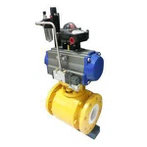
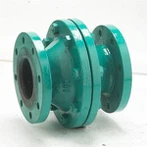
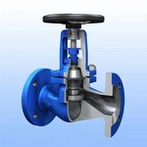
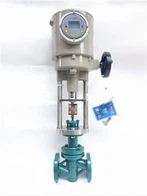
The control valve belongs to the series of control valves. Its main function is to adjust the pressure, flow, temperature and other parameters of the medium, and it is the final control element in the process loop. According to the stroke characteristics, the regulating valve can be divided into: straight stroke and angular stroke. Straight stroke includes: single seat valve, double seat valve, sleeve valve, angle valve, three-way valve, diaphragm valve; angular stroke includes: butterfly valve, ball valve, eccentric rotary valve, full-featured ultra-light control valve. The regulating valve can be divided into: pneumatic regulating valve, electric regulating valve and hydraulic regulating valve according to the driving mode; according to the regulating form, it can be divided into: regulating type, cut-off type, regulating and cutting-off type; according to the flow characteristics, it can be divided into: linear, equal percentage , Parabolic, Quick Open. The regulating valve is suitable for air, water, steam, various corrosive media, mud, oil and other media.
The regulating valve is used to regulate the flow, pressure and liquid level of the medium. According to the signal of the adjustment part, the opening of the valve is automatically controlled, so as to achieve the adjustment of the medium flow, pressure and liquid level.
The regulating valve is divided into electric regulating valve, pneumatic regulating valve and hydraulic regulating valve, etc. This manual mainly introduces two types of electric control valve and pneumatic control valve. The regulating valve consists of two parts, an electric actuator or a pneumatic actuator and a regulating valve. The adjustment is usually divided into two types: straight-through single-seat type and straight-through two-seat type. The latter has the characteristics of large flow capacity, small unbalanced operation and stable operation, so it is usually especially suitable for occasions with large flow, high pressure drop and less leakage. The flow capacity Cv is one of the main parameters for selecting the regulating valve.
The flow capacity of the control valve is defined as: when the control valve is fully open, the pressure difference between the two ends of the valve is 0.1MPa, and the fluid density is 1g/cm3, the flow rate of the flow path control valve per hour is called the flow capacity, also known as the flow capacity. The flow coefficient is expressed in Cv, and the unit is t/h. The Cv value of the liquid is calculated as follows. The nominal diameter DN of the regulating valve can be determined by looking up the table according to the value of the flow capacity Cv. The flow characteristic of the regulating valve is the relationship between the relative flow of the medium flowing through the regulating valve and its opening degree under the condition that the pressure difference between the two ends of the valve remains constant. The flow characteristics of the regulating valve include linear characteristics, equal percentage characteristics and parabolic characteristics.
The relative stroke and relative flow of equal percentage characteristics are not in a linear relationship. The change in flow caused by the change of unit stroke at each point of the stroke is proportional to the flow at this point, and the percentage of flow change is equal. Therefore, its advantage is that when the flow rate is small, the flow rate change is small, and when the flow rate is large, the flow rate change is large, that is, it has the same adjustment accuracy at different opening degrees. The relative stroke of the linear characteristic and the relative flow are in a linear relationship. The flow change caused by the change of unit stroke is constant. When the flow rate is large, the relative flow value changes little, and when the flow rate is small, the relative flow value changes greatly. Regulating valves include throttle valves and pressure reducing valves, whose function is to adjust the pressure, flow and other parameters of the medium.
Control valves are divided into nine categories according to their structure: single-seat control valve; double-seat control valve; sleeve control valve; angle control valve; three-way control valve; diaphragm valve; butterfly valve; ball valve; eccentric rotary valve. The first six are straight strokes, and the last three are angular strokes. Regulating valve, used to regulate the flow, pressure and level of the medium. According to the signal of the adjustment part, the opening of the valve is automatically controlled, so as to achieve the adjustment of the medium flow, pressure and liquid level. The regulating valve consists of two parts, an electric actuator or a pneumatic actuator and a regulating valve. The adjustment is usually divided into two types: straight-through single-seat type and straight-through two-seat type. The latter has the characteristics of large flow capacity, small unbalanced operation and stable operation, so it is usually especially suitable for occasions with large flow, high pressure drop and less leakage.