Electric valve
Valve electric actuators are mainly used in power plants or nuclear power plants, because a smooth, stable and slow process is required in high pressure water systems. The main advantages of electric actuators are high stability and constant thrust that can be applied by users. The thrust generated by the actuator can be as high as 225,000kgf. Only hydraulic actuators can achieve such a large thrust, but the cost of hydraulic actuators is higher than that of electric ones. a lot of. The anti-deviation ability of the electric actuator is very good, and the output thrust or torque is basically constant, which can well overcome the unbalanced force of the medium and achieve accurate control of the process parameters, so the control accuracy is higher than that of the pneumatic actuator. high. If it is equipped with a servo amplifier, it is easy to realize the exchange of positive and negative effects, and it is also possible to easily set the state of the valve position of the off signal (hold/full open/full close), and when a fault occurs, it must stay in the original position. Pneumatic actuators cannot do it, and pneumatic actuators must be kept in place with the help of a combined protection system.
The main disadvantages of electric actuators are:
The structure is more complex, and it is more prone to failure, and because of its complexity, the technical requirements for on-site maintenance personnel are relatively higher; the operation of the motor generates heat, if the adjustment is too frequent, it is easy to cause the motor to overheat, resulting in thermal protection, and at the same time It will also wear down the reduction gear; in addition, the operation is slow, and it takes a long time from the regulator to output a signal to the response of the regulator valve to move to the corresponding position, which is not as good as pneumatic and hydraulic actuators. place.
Pneumatic valves
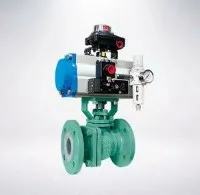
The actuator and adjustment mechanism of the valve pneumatic actuator are a unified whole, and the actuator has two types: diaphragm type and piston type. The piston type has a long stroke and is suitable for occasions requiring large thrust; while the diaphragm type has a small stroke and can only directly drive the valve stem. Because the pneumatic actuator has simple structure, large output thrust, stable and reliable action, it is widely used in power plants, chemical industry, oil refining and other production processes with high requirements.
The main advantages of pneumatic actuators:
It accepts continuous gas signal and outputs linear displacement (continuous electrical signal can also be accepted after the power/gas conversion device is applied), and some can output angular displacement when equipped with rocker arm.
There are positive and negative functions.
The movement speed is high, but the speed becomes slower when the load increases.
The output force is related to the operating pressure.
High reliability, but the valve can not be maintained after the air supply is interrupted (it can be maintained after adding a retaining valve).
It is inconvenient to realize segment control and program control.
The maintenance is simple and the adaptability to the environment is good.
The output power is larger.
With explosion-proof function.